Titan Direct Indexing


Over $1 Trillion of assets worldwide, and counting, have moved to direct indexed products

This is because direct indexing means owning individual stocks in an index directly, rather than through a fund or ETF, enabling tax-loss harvesting opportunities.

Tax-loss harvesting can add 1%-2% in excess returns each year.
Most investors hold the S&P 500 through a single ETF. It's a great starting point, but it buries a critical fact: in any given year, roughly 115 of those 500 individual stocks trade at a loss. Direct indexing means owning individual stocks in an index directly, rather than through a fund or ETF, enabling potential tax-loss harvesting of ~1-2% returns per year.

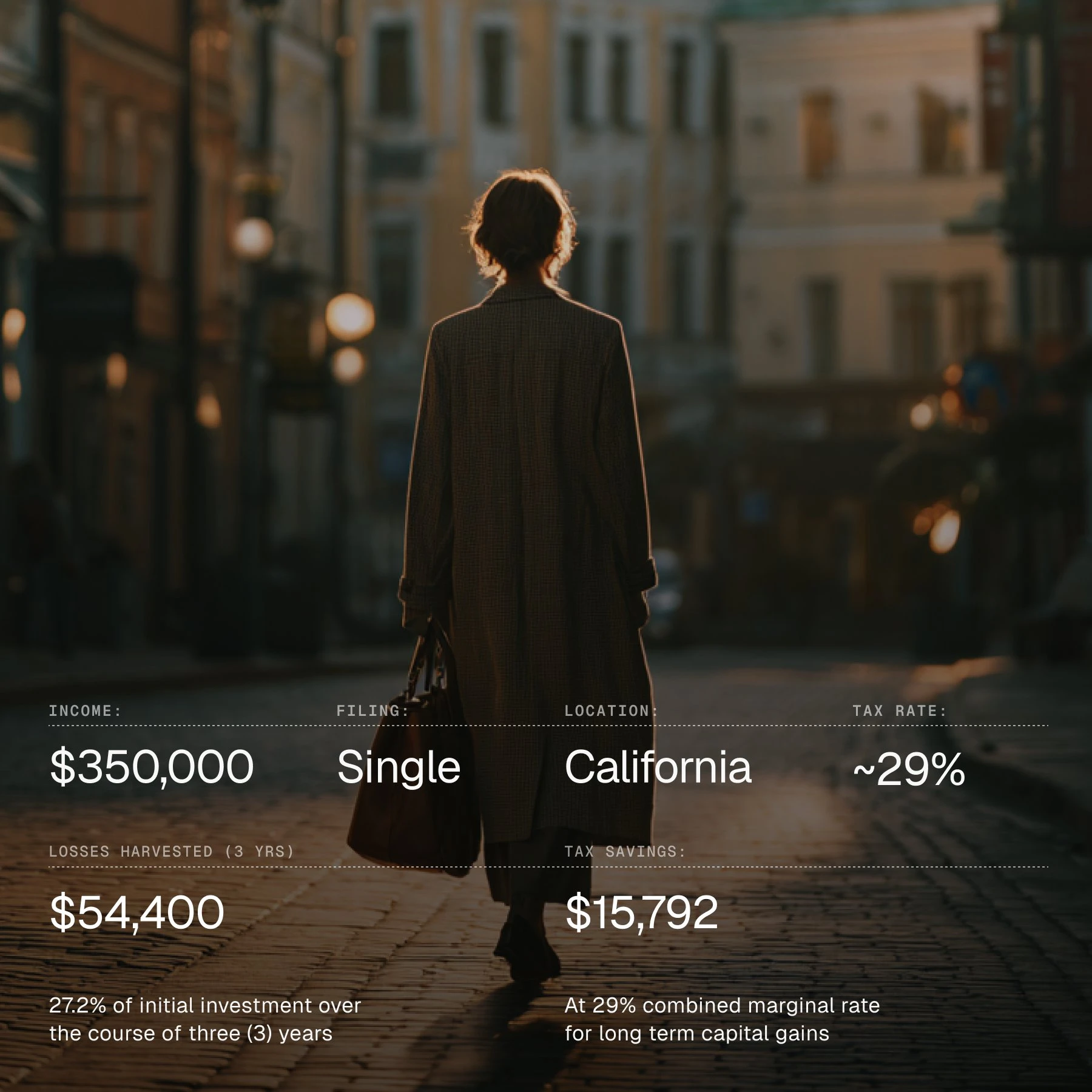
Let's say an illustrative Titan client, Sarah,* earns $350,000 annually as a single filer in California. She holds a brokerage account invested in the S&P 500 and receives RSU vests each quarter. She moves her portfolio into Titan Direct Indexing, same index exposure, but now each position can be individually harvested for losses.
Over three years, Sarah's account harvests $54,400 in losses, 27.2% of her initial investment. At her ~29% combined federal and California marginal rate, that translates to $15,792 in tax savings. Harvesting is front-loaded and most occurs in the first 2 to 3 years, but recurring deposits help reload the tax loss bank over time, keeping the engine running year after year.
Direct indexing was historically a $5M+ minimum at legacy wealth managers. We brought the threshold down and the technology forward.


Pharetra massa id sem ullamcorper est lacus nulla turpis. A mauris congue nisi consequat viverra non ullamcorper bibendum. Non sollicitudin pulvinar non justo leo sodales sed tempus auctor. Cras ornare nunc feugiat suscipit fusce faucibus suspendisse odio. Eleifend tincidunt donec habitasse sit varius. Justo vitae iaculis sit hac facilisi lectus. Felis in amet dolor duis mauris nibh.
Same Index. New Playbook.
Step 1) We buy up to 500 securities
Your portfolio mirrors the S&P 500. Same basket, same weight, designed to track the same return as the ETF you'd otherwise own.
Step 2) Algorithms scan for losses
Our system checks every holding against its cost basis. When a stock dips below what you paid, we may sell it and reinvest in a correlated position — locking in the loss without changing your index exposure.
Step 3) Losses accrue in your reserve
Harvested losses don't expire. They carry forward indefinitely, building a reserve you can deploy against future gains — an RSU vest, a real estate sale, a windfall.
Step 4) You offset gains when it matters
When a taxable event hits, your accumulated losses reduce the bill dollar-for-dollar. The longer you hold, the larger the reserve grows.

What is Direct Indexing and how does it work?
Direct Indexing is Titan's tax-optimized equity strategy that lets you own the individual stocks inside the S&P 500 rather than a single ETF. By holding each position separately, our algorithms can identify and harvest losses in declining stocks while keeping your overall index exposure intact. Those harvested losses build a reserve you can use to offset future taxable gains from RSU vests, real estate sales, or any other taxable event.
How do I begin using Direct Indexing?
Get in touch with one of our Advisors. You can click the "Talk to an Advisor" button below.
What is the minimum to get started?
Direct Indexing requires a minimum of $20,000 to open an account. This threshold was historically $5 million or more at legacy wealth managers. Titan brought that number down so more investors can access the same institutional-grade tax strategy.
Disclosures
* The example is illustrative and based on historical simulation data. Actual results vary based on market conditions, individual tax situation, and portfolio activity. Figures shown are hypothetical and do not represent actual client results.
** The 1.16% tax alpha figure is hypothetical and based on backtested analysis of a direct indexing portfolio that generated a 28.19% annualized after-tax return compared to 27.03% for a buy-and-hold benchmark. Derived from Apex Fintech Solutions' Direct Indexing backtest conducted over the period January 2013 through December 2024 using the following standard persona configuration: $100,000 starting AUM, 1% tracking error budget, 10% security bands, 1% band violation penalty, 20% maximum portfolio turnover limit, 80% maximum securities held, 43% short-term and 23% long-term capital gains tax rate, a tax penalty parameter of 10, and a monthly (22 trading days) rebalancing frequency. Titan's Direct Indexing product uses a $20,000 account minimum, a tax penalty parameter of 5, and a band violation penalty of 10%; all other parameters are consistent with the standard persona configuration above. The difference in results between Apex's standard persona configuration and Titan's configuration is not material to the figures provided. The tax rates used reflect the combined federal and state rate applicable to high-income investors in high-tax states such as California and may be higher than the rate applicable to your individual circumstances. Clients in lower tax brackets or lower-tax states will generally experience lower tax benefits than shown. Actual results will vary based on individual tax rates, account size, market conditions, contributions, and other factors. Backtested performance is hypothetical, does not reflect actual client results, and is not indicative of future performance.
Direct Indexing is available in taxable accounts only and is not appropriate for tax-advantaged accounts. Please note that the number of individual securities held in a Direct Indexing account varies based on account size and may be significantly fewer than the full 500 constituent securities of the S&P 500® index. Tax-loss harvesting is not guaranteed to reduce your tax liability in any given year. Harvesting opportunities depend on market conditions, portfolio composition, your individual cost basis, and the timing and size of contributions. Harvested losses defer taxes rather than eliminate them. Harvested losses that exceed your realized capital gains in a given year can only offset up to $3,000 of ordinary income annually (or $1,500 if married filing separately). Losses in excess of this amount are carried forward to future tax years. Titan does not provide tax advice and nothing in this content is a substitute for the advice of a qualified tax advisor, as Titan is not a tax professional. Please consult a qualified tax professional regarding your specific circumstances. Individual experiences and outcomes vary based on unique circumstances. Tax laws are complex and subject to change. Tax-loss harvesting opportunities are generally greatest shortly after initial funding and may diminish over time as securities appreciate. Any hypothetical or illustrative figures shown are based on assumptions that may not reflect actual market conditions or individual circumstances. Hypothetical performance does not represent actual results and is not a guarantee of future outcomes.
The S&P 500® index is a product of S&P Dow Jones Indices LLC ("SPDJI"). Standard & Poor's® and S&P® are registered trademarks of Standard & Poor's Financial Services LLC. Titan's Direct Indexing is designed to track the S&P 500 using the iShares Core S&P 500 ETF (IVV), a product of BlackRock, Inc., as a benchmark proxy. This product is not sponsored, endorsed, sold, or promoted by SPDJI, Dow Jones, S&P, BlackRock, iShares, or any of their respective affiliates, and none of such parties make any representation regarding the advisability of investing in this product. Your Direct Indexing portfolio may hold a subset of S&P 500 constituent securities and is not designed to replicate the index exactly. Performance and volatility may differ materially from the S&P 500 or IVV due to factors including cash flows, rebalancing, tax-loss harvesting, securities sampling, transaction costs, and index composition changes. The S&P 500 is an unmanaged, market capitalization-weighted index representing U.S. large cap equity performance. Benchmark returns referenced herein include reinvestment of dividends and do not reflect advisory fees, transaction costs, tax effects, or other expenses that would reduce actual returns.
The views, opinions, and descriptors used should not be construed as promises of quality or guarantees of performance or future results. When Titan refers to “same,” “mirrors,” “tracks,” in connection with an index, these terms describe the investment objective of the Direct Indexing offering and do not represent a guarantee of equivalent returns, tax savings, or investment outcomes. Actual results will vary based on market conditions, individual tax circumstances, and portfolio activity. References to “tax loss points bank” refer to the accumulated harvested losses available to offset future capital gains, also referred to as a tax loss reserve. References to tax-loss harvesting adding 1%–2% in excess returns are based on third-party academic research. Direct Indexing is subject to market risk and is not guaranteed to generate a specific outcome or increase after-tax returns. The mention of specific securities, asset classes, or investment strategies does not constitute a recommendation or endorsement.
For more information, see Direct Indexing Risks and Disclosures.